
How to Search Muskogee County Court Records
The main search tool for county cases is On Demand Court Records, known as ODCR. The Muskogee County Court Clerk links to it directly as the office "Search Court Records" path. ODCR pulls public District Court cases from participating Oklahoma courts, and Muskogee is one of them. Basic searching and docket viewing are free. You can look up a case by a party name or by the full case number, then read the chronological docket without paying.
Court records open fastest when you know what you have on hand. A full name, an approximate filing year, or a case number with its letter prefix all narrow the results. The ODCR search portal is the locally endorsed starting point for that work.
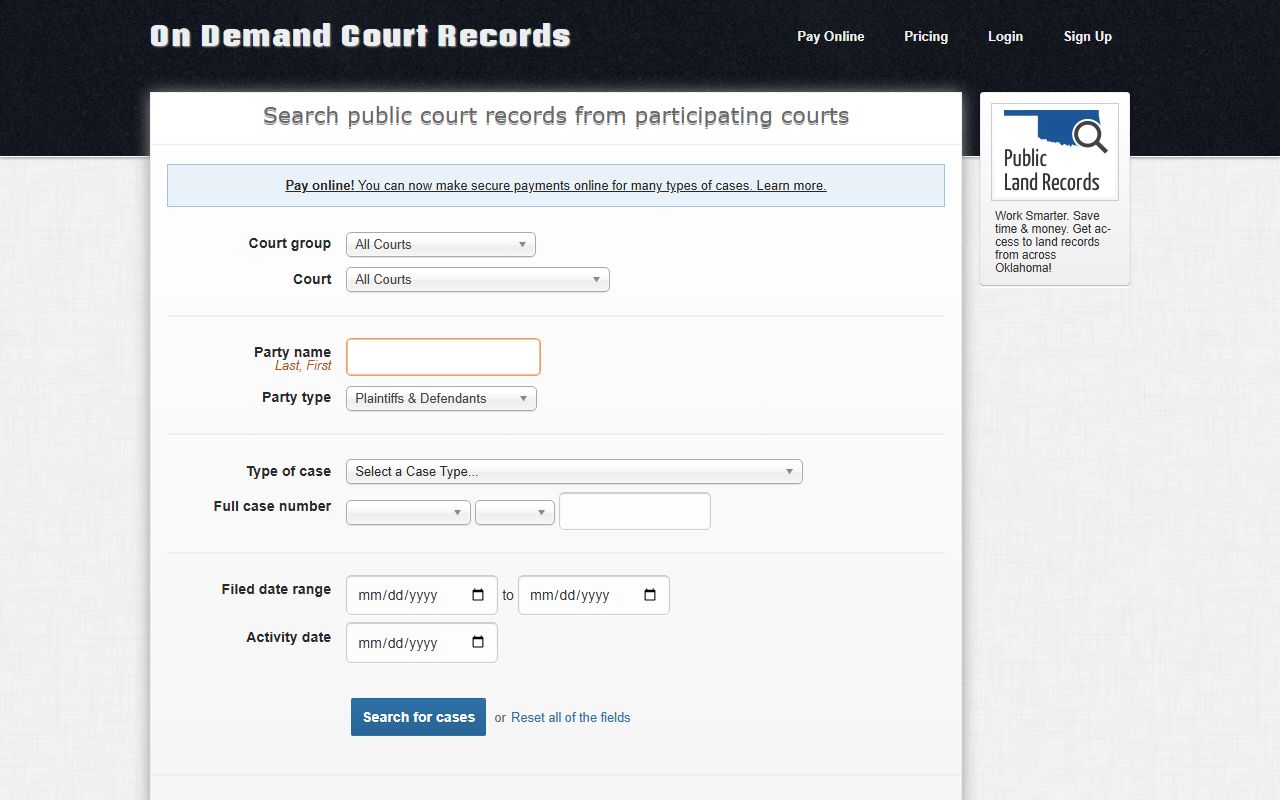
The screen groups its fields by court, party, case type, and date. That layout lets you switch between a broad name search and a precise case-number lookup in a few clicks.
A clean search usually moves through the same steps in order. The list below mirrors the path the county clerk's own link sets up.
- Open the Court Clerk page and use its Search Court Records link to reach ODCR.
- Choose Oklahoma District Courts as the court group and Muskogee as the court.
- Search by party name in Last, First format, or switch to All Parties for a wider net.
- Use the case type menu to separate felony, misdemeanor, probate, family, traffic, and small claims records.
- Enter a case number with its prefix when a citation or clerk notice gives one.
- If nothing returns, check OSCN or call the clerk, since old, sealed, or newly filed cases may not show online.
ODCR exposes several search fields, each aimed at a different way of finding a case. The fields and their formats are set out here.
| Field | Type | How to Use It |
|---|---|---|
| Court group | Dropdown | All Courts, Oklahoma District Courts, or Tribal Courts |
| Court | Dropdown | Pick Muskogee for county District Court cases |
| Party name | Text | Enter in Last, First format |
| Party type | Dropdown | Plaintiffs and Defendants, or All Parties |
| Type of case | Dropdown | Civil, criminal felony, misdemeanor, probate, family, traffic, small claims, search warrants, and more |
| Full case number | Text plus code | Prefixes such as CF, CM, CV, FD, PB, SC, SW, and TR |
| Filed date range | Date | Narrow results by the date a case was filed |
| Activity date | Date | Narrow by the date of the latest docket activity |
Where Muskogee County Court Records Are Kept
Three offices hold most local records, and they are not the same place. The Muskogee County Court Clerk keeps the permanent records of District Court cases. The County Clerk is a separate office that handles land records, deeds, liens, and county filings. The Municipal Court keeps city ordinance cases. Sending a request to the wrong counter is the most common reason a search stalls.
Court Clerk Robyn Boswell has led the office since 2021. Her staff records civil, probate, juvenile, domestic relations, and small claims matters, issues marriage and certain other licenses, and collects fines and court costs. The office answers to the Oklahoma Court Administrator and the state Supreme Court. Land questions go elsewhere. County Clerk Polly Irving runs the recording office and offers a free property-monitoring tool through OkCountyRecords so owners learn when a document is filed against their name.
The county publishes both office pages online. Use the Court Clerk office for case files and the County Clerk office for land records.
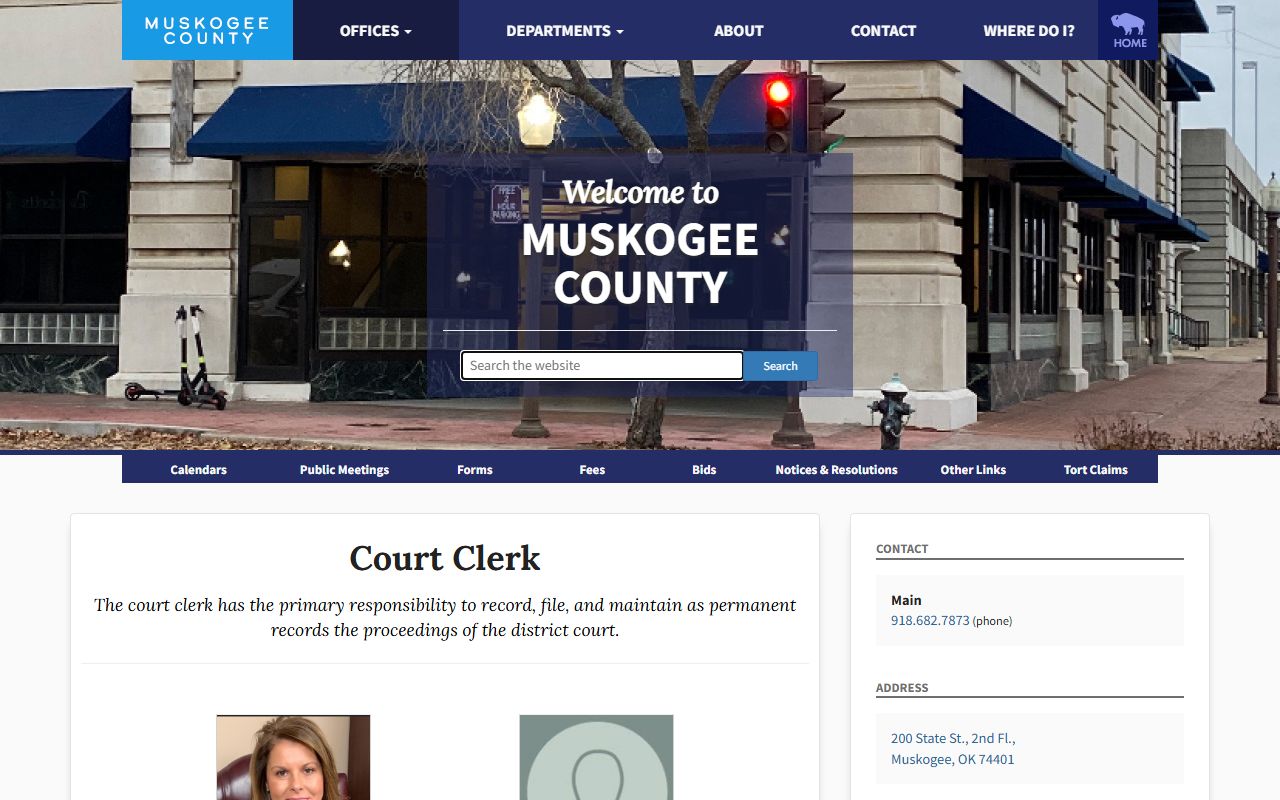
That page lists the clerk's duties, hours, and the direct link to the court record search. It is the right county source when you want a District Court file rather than a deed.
The Muskogee County Judicial System
Oklahoma runs its trial work through District Courts, and Muskogee County belongs to Judicial District 15. That district also covers Adair, Cherokee, Sequoyah, and Wagoner Counties. District judges hear both civil and criminal matters, which is why most case types route to the same trial court. Judge Timothy King and Judge Bret Smith serve as District 15 district judges. Associate District Judge Norman Thygesen handles divorce, probate, juvenile, and criminal dockets.
Appeals split by subject. Civil appeals move toward the Oklahoma Court of Civil Appeals and the Oklahoma Supreme Court. Criminal appeals go to the Oklahoma Court of Criminal Appeals. The state describes this structure on its District Courts overview, and the official district judge page names the District 15 bench.
Case flow: Municipal Court (city ordinance) and District Court (general jurisdiction) at the trial level › civil appeals to the Oklahoma Court of Civil Appeals and Oklahoma Supreme Court › criminal appeals to the Oklahoma Court of Criminal Appeals.
| Court | Jurisdiction | Case Types |
|---|---|---|
| Oklahoma Supreme Court | Highest civil court | Final civil appeals and court administration |
| Oklahoma Court of Criminal Appeals | Highest criminal court | Final criminal appeals |
| Oklahoma Court of Civil Appeals | Intermediate appellate | Civil appeals assigned by the Supreme Court |
| District Court (District 15) | General trial jurisdiction | Felony, misdemeanor, civil, family, probate, juvenile, small claims |
| Municipal Court | Limited city court | City ordinance traffic, parking, and non-traffic cases |
The statewide docket tool reflects this same map. OSCN lists Muskogee County District Court in its court dropdown alongside the other county courts.
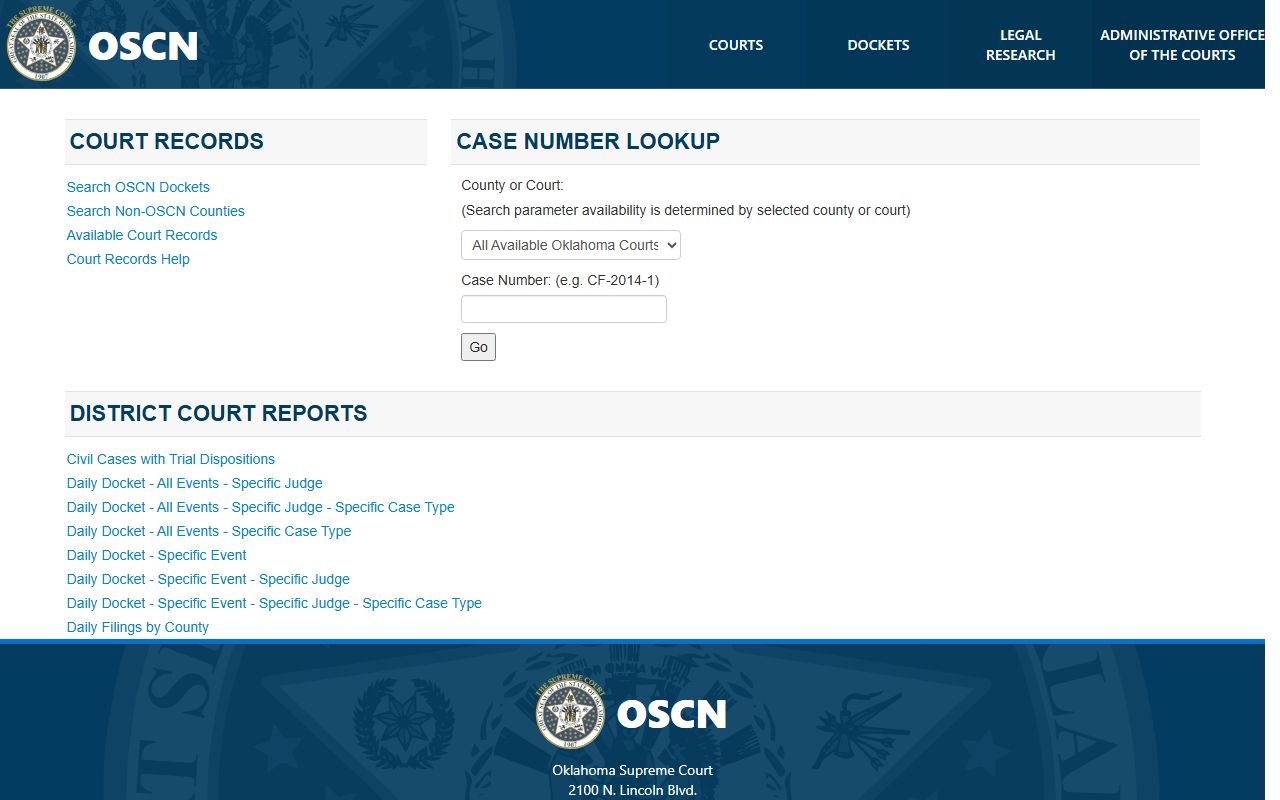
You can reach that search through the OSCN docket search page. A turnstile check may appear, so a quick human verification step is sometimes needed before results load.
Types of Court Records Available in Muskogee County
The District Court produces a wide spread of public files, and each carries its own case-type label in ODCR. Civil and criminal cases sit side by side with family, probate, and small claims matters. City ordinance tickets are different and live with the Municipal Court instead. Knowing the right category up front saves time, because the search menu sorts results by exactly these types.
The most common record groups break down this way.
- Criminal records - felony and misdemeanor case files with charges, pleas, disposition, and sentence.
- Civil records - petitions, answers, motions, judgments, garnishments, and liens.
- Family and divorce records - dissolutions, custody, support, and paternity matters.
- Probate records - estates, wills, guardianships, conservatorships, and trusts.
- Traffic records - District Court traffic tickets, plus city tickets handled by the Municipal Court.
Juvenile, mental health, and protective-order cases also appear as case types, but those carry tighter access rules. A label like Drug Court or Mental Health Court is part of the public docket, yet the underlying file may be limited.
What Muskogee County Court Records Show
An online case record reads as a running list of events tied to a single case number. The number itself carries a prefix, a year, and a sequence, which tells you the case type at a glance. Below that sit the parties, the assigned court, the filing date, and a docket of dated entries. Each entry marks something that happened, from the first filing through hearings, motions, orders, and the final outcome.
| Field | What It Shows |
|---|---|
| Case Number | Prefix, year, and sequence that mark the case type and court |
| Filing Date | The date the case was opened with the clerk |
| Parties | Plaintiff, defendant, petitioner, respondent, the state, or a city |
| Charges / Cause | The alleged offense in a criminal case or the basis of a civil claim |
| Docket Entries | Dated filings, hearings, bonds, continuances, motions, and orders |
| Disposition | The final outcome of the case or a single charge |
| Sentence / Judgment | The punishment or the money decision after a ruling |
Document images are a separate question. Free docket viewing shows the list of entries, but the scanned filings behind them may be limited, paid, or absent depending on the court and the record. Social Security numbers, account numbers, and details about minors are redacted by rule.
Understanding Muskogee County Court Record Terms
Court files use a shorthand that trips up first-time readers. A docket can pack a hearing, a bond, and a ruling into a few clipped lines. Learning a handful of core terms makes the rest of the entry readable. A few of the words that show up most often are defined here.
- Plaintiff
- The party who starts a civil case against another.
- Defendant
- The party who is sued or accused in a case.
- Disposition
- The final outcome of a case or a single charge.
- Bond
- Money or security used to secure release and a court appearance.
- Bench warrant
- A warrant a judge issues, often for a failure to appear.
- Expungement
- The legal sealing or removal of a qualifying record.
A guilty or no-contest plea differs from a conviction in how it reads on the docket, and a dismissal can be with or without prejudice. Those small words change what the record means.
Public Access Laws for Muskogee County Court Records
Oklahoma treats government records as open by default. The Open Records Act sets that policy, and county and city offices answer requests under it. Court files carry their own layer of rules, and some records stay confidential by statute or court order. When a record is not online and is not sealed, the fallback is an in-person, mail, or written request to the office that created it. The key statutes are summarized here in plain terms.
Key Statutes:
51 O.S. § 24A.1 - Names and sets up the Oklahoma Open Records Act used for public-record requests.
51 O.S. § 24A.2 - States the policy that residents should be able to see what their government does.
51 O.S. § 24A.5 - Makes public records open unless a specific law marks them confidential.
51 O.S. § 24A.8 - Covers law-enforcement records open for public inspection, with limits on protected detail.
22 O.S. § 18(A) - Lists who is eligible to seek an expungement of a criminal record.
Restricted and Confidential Court Records
Not every case is open to a public search. Juvenile case records are not treated like ordinary adult dockets, and the clerk can confirm what access applies. Mental health proceedings, adoption files, and sealed or expunged cases are also held back. A docket may show that a case exists while the underlying detail stays protected.
Clearing a record runs through a defined path. A person first identifies the exact case and arrest in ODCR, OSCN, or OSBI criminal history, then compares the outcome to the eligibility categories. The petition is filed in the court with authority over the case, which is the Muskogee County District Court for local matters. The state may object even when a person appears to qualify. The OSBI expungement page explains that the agency cannot pre-approve eligibility and that the age of a record alone does not disqualify someone.
Comparing Muskogee County Court Types
People often mix up the three courthouses that share downtown Muskogee. The District Court, the city Municipal Court, and the federal court each handle different cases and keep records in different places. A side-by-side view makes the split clear and points a search at the right office.
| Feature | District Court | Municipal Court | Federal Court |
|---|---|---|---|
| What it handles | Felony, civil, family, probate | City ordinance, traffic, parking | Federal crimes and civil cases |
| Where records live | County Court Clerk | Municipal Court Division | Eastern District of Oklahoma |
| Online search | ODCR and OSCN | City warrant and payment tools | PACER and CM/ECF |
| Appeals go to | State appellate courts | District Court | Tenth Circuit |
The split matters most for traffic. A city ticket and a District Court traffic case are filed in different systems, so a name that returns nothing in ODCR may still sit on the Municipal Court rolls.
Specialty Courts in Muskogee County
Oklahoma court systems recognize problem-solving dockets, and ODCR carries case-type labels for them. Drug Court and Mental Health Court both appear as categories a Muskogee case can fall under. These programs route eligible defendants into treatment and supervision rather than a standard sentence.
The county sources do not publish a full program page for either court, so admission rules, length, and graduation terms are not spelled out locally. If a case shows a Drug Court or Mental Health Court label, that label is part of the public record. Confirm eligibility and program detail with the Muskogee County Court Clerk or the District Attorney before relying on it.
Note: A specialty-court label on a docket records the case type, but program admission and outcomes should be confirmed with the clerk or the District Attorney.
Muskogee County Sheriff, Jail, and Warrants
Sheriff Andy Simmons runs the county jail and its inmate roster. The Sheriff's Office inmate search shows people held in custody, sorted by booking date, with the booking date, charges, and related detail. When a name returns nothing, the page points to VINE to check whether the person was released or transferred. Sentenced state prisoners move to the Oklahoma Department of Corrections offender lookup instead. The inmate search page and the DOC offender lookup cover those two paths, and the full roster detail lives on the Muskogee County inmate records page.
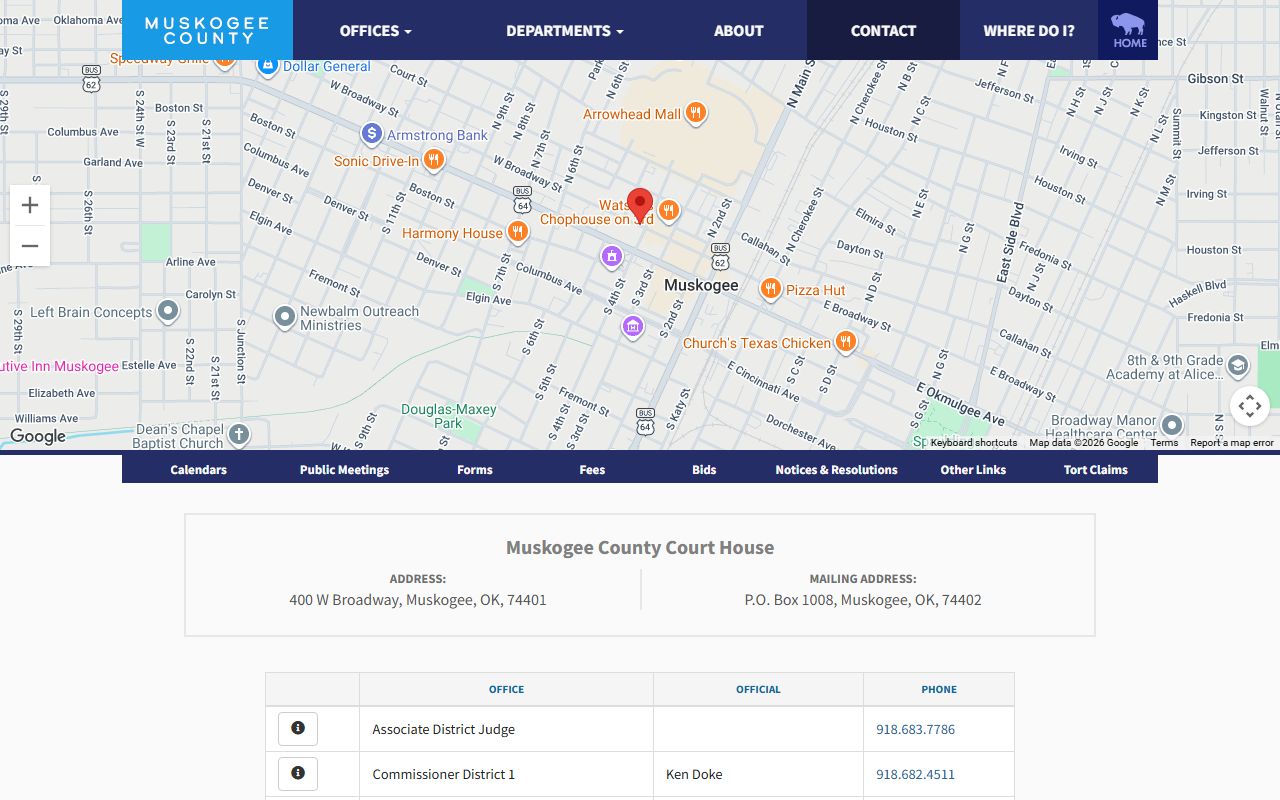
The county contact directory lists the sheriff, the courts, the district attorney, and the clerk offices in one place. It is a useful map when a search needs a phone number rather than a database.
Warrants split by court. The City of Muskogee runs a local warrant search by last and first name, and a hit there should be confirmed with the Municipal Court Clerk by phone. County bench warrants show on District Court criminal dockets. The Sheriff's Most Wanted page is a tip list, not a legal warrant check, and it warns readers not to attempt any apprehension. Active-warrant detail and the resolution steps sit on the warrant records page.
Marriage, Divorce, and Probate Records
The Court Clerk issues marriage licenses and records them as a District Court case type. Divorce and dissolution files are District Court records too, and Associate District Judge Norman Thygesen carries the divorce docket. Probate is not a separate county court. It runs as the Probate Division of the Muskogee County District Court, with the same judge over estates, wills, guardianships, and trusts. All three search the same way through ODCR by party name or case number.
Detailed steps and fees for each live on the dedicated pages. Start with marriage and divorce records for license and dissolution work, and use probate records for estate and guardianship cases.
- Testator
- A person who leaves a valid will at death.
- Executor
- The person named to carry out the terms of a will.
- Conservator
- A person a court appoints to manage another's property or affairs.
Muskogee County Court Records Fees
Copy and recording charges depend on which office you use. The County Clerk publishes a fee schedule for land records, copies, and certifications. The Court Clerk fees for District Court cases are set by the statewide OSCN fee and bond schedules rather than a separate local table. Online searching and docket viewing through ODCR stay free, so most fees apply only when you ask for paper copies.
| Item | Amount |
|---|---|
| Photographic copies of records | $1 per page |
| Certifying a document | $1 |
| Preservation fee per document filed | $10 |
| Documentary stamp tax | $0.75 per $500 of consideration |
| First page of other liens | $8 |
| Each additional page of the same instrument | $2 |
The full breakdown, including plat recording and 911 copy charges, is posted on the county fee page. Confirm court-case copy costs with the Court Clerk, since those follow the state schedule.
Federal Court in Muskogee County
A federal courthouse sits in downtown Muskogee, and its files are not county records. The U.S. District Court for the Eastern District of Oklahoma handles federal crimes, civil-rights suits, federal-question cases, and diversity cases. Bankruptcy moves through the U.S. Bankruptcy Court for the same district, and appeals go to the Tenth Circuit. Because the building is close to the county courts, people sometimes search the wrong system.
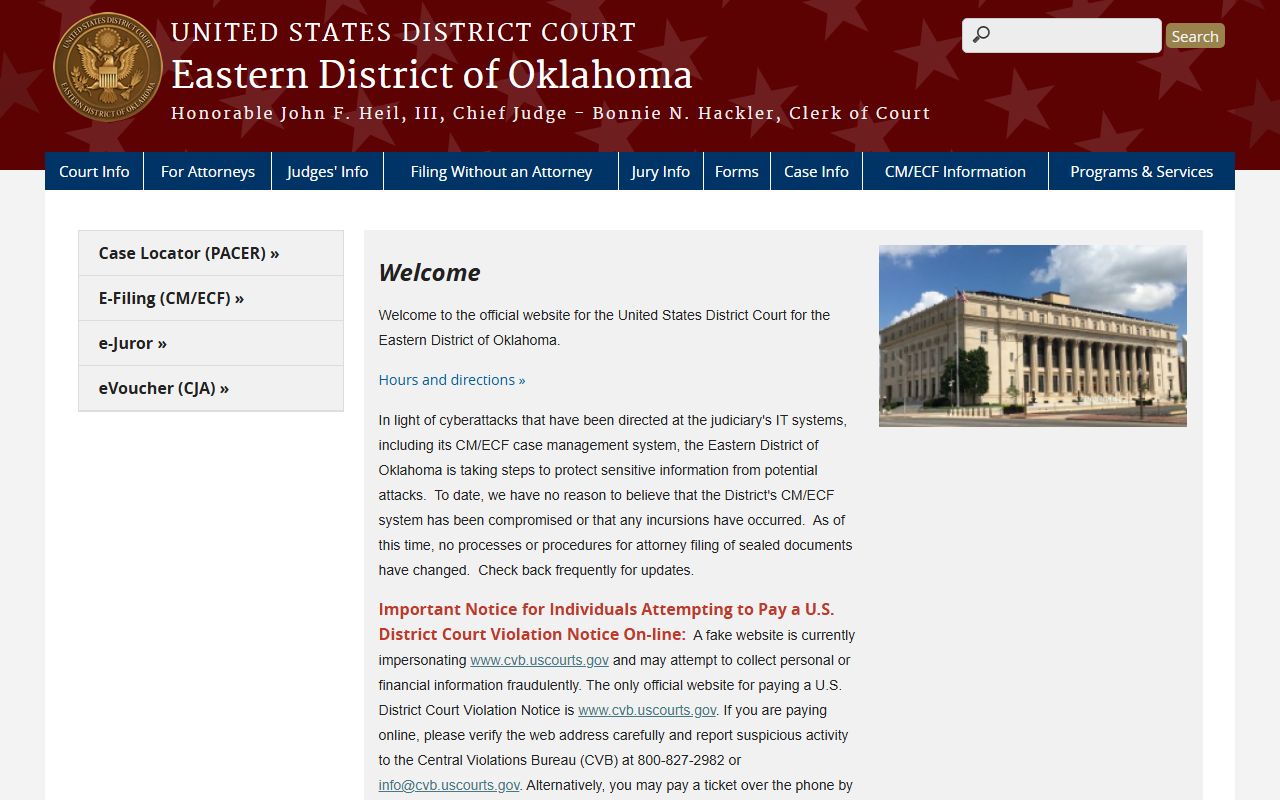
The Eastern District of Oklahoma site links PACER, CM/ECF e-filing, the daily calendar, and local rules. Federal docket records run through PACER, where fees may apply, rather than through ODCR or the county clerk.
History of Muskogee County Courts
Muskogee County and its seat take their name from the Muscogee (Creek) Nation, and the post office settled on the Muskogee spelling in 1900. The county counted 37,467 residents at statehood in 1907 and grew quickly in the decades that followed. The Oklahoma Historical Society puts the county area at roughly 839 square miles. That growth built the cluster of legal buildings that still defines downtown Muskogee.
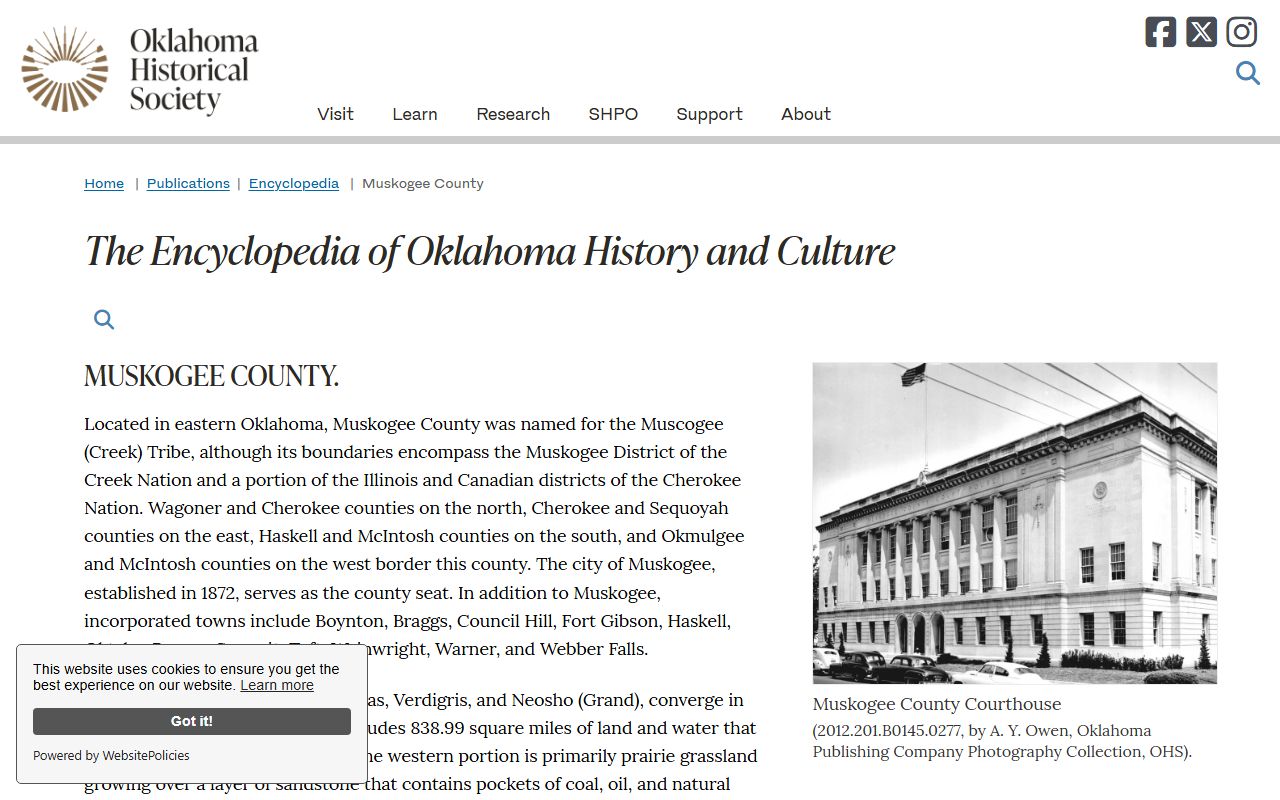
The Oklahoma Historical Society entry lays out the county's population and background. The Muskogee County Courthouse is also a National Register property, listed under the County Courthouses of Oklahoma group.
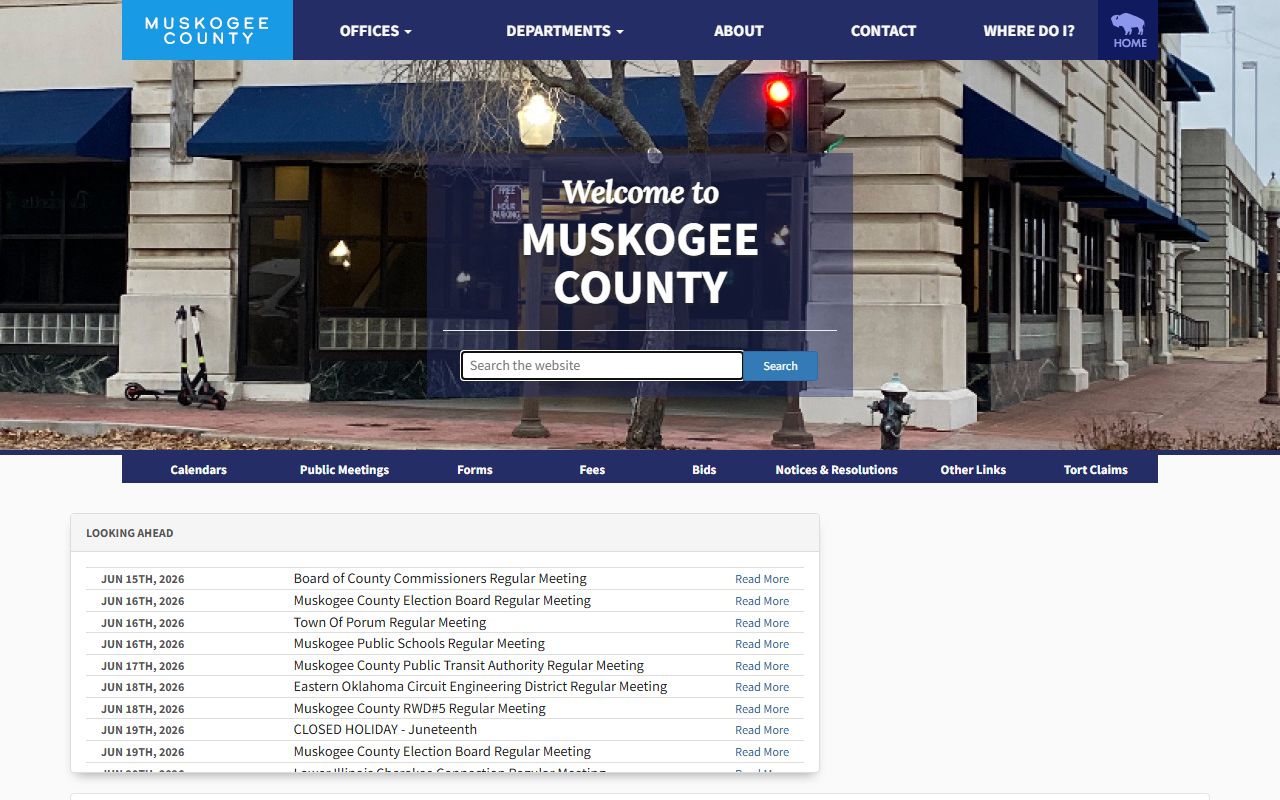
Today the county landing page gathers the office, courthouse, forms, and fee links in one spot. It is the simplest entry point for residents new to the local system.
Muskogee County Courthouse Locations
County offices spread across several downtown buildings, so one counter does not handle every record. The Broadway courthouse holds county-record offices, the Court Clerk sits on State Street, and the District Judge and District Attorney share another State Street address. The Municipal Court works inside the police station. Knowing which door to use before you arrive saves a wasted trip.
District Court & District Attorney
220 State Street
Muskogee, OK 74401
918-687-6388
Frequently Asked Questions
Where do I search Muskogee County court records online?
Start with ODCR, the portal the Court Clerk links as its Search Court Records path. Choose Oklahoma District Courts as the group and Muskogee as the court, then search by party name or case number. OSCN is a statewide backup that also lists Muskogee County District Court. Both allow free searching and docket viewing.
Is there a fee to view Muskogee County court records?
Basic searching and docket viewing on ODCR are free. Fees apply mainly when you request paper or certified copies. County Clerk copies run about a dollar per page with a one dollar certification charge, while court-case copy costs follow the statewide OSCN fee schedule.
What is the difference between the Court Clerk and the County Clerk?
The Court Clerk keeps District Court case files, issues marriage licenses, and collects fines and court costs. The County Clerk is a separate office that records land documents, deeds, and liens. Court cases go to the Court Clerk, and property records go to the County Clerk.
How do I check for a warrant in Muskogee County?
City warrants appear in the Muskogee Municipal Court warrant search by last and first name, and a hit should be confirmed with the Municipal Court Clerk. County bench warrants show on District Court criminal dockets in ODCR. The Sheriff's Most Wanted page is a tip list, not a full warrant check.
Are juvenile and sealed cases public?
No. Juvenile records are not treated like adult dockets, and sealed or expunged cases are held back from ordinary searches. A docket may confirm a case exists while the detail stays protected. Contact the Court Clerk to learn what access, if any, applies to a specific file.
Why does a case not show up in ODCR?
Several reasons are common. The case may be very old, recently filed, sealed, or indexed under a different spelling. City ordinance and traffic matters sit with the Municipal Court rather than the District Court. If a search returns nothing, check OSCN or call the Court Clerk.
Are federal court cases part of the county records?
No. The federal courthouse in Muskogee belongs to the U.S. District Court for the Eastern District of Oklahoma. Its dockets run through PACER and CM/ECF, not through ODCR or the county Court Clerk, even though the building stands downtown near the county courts.